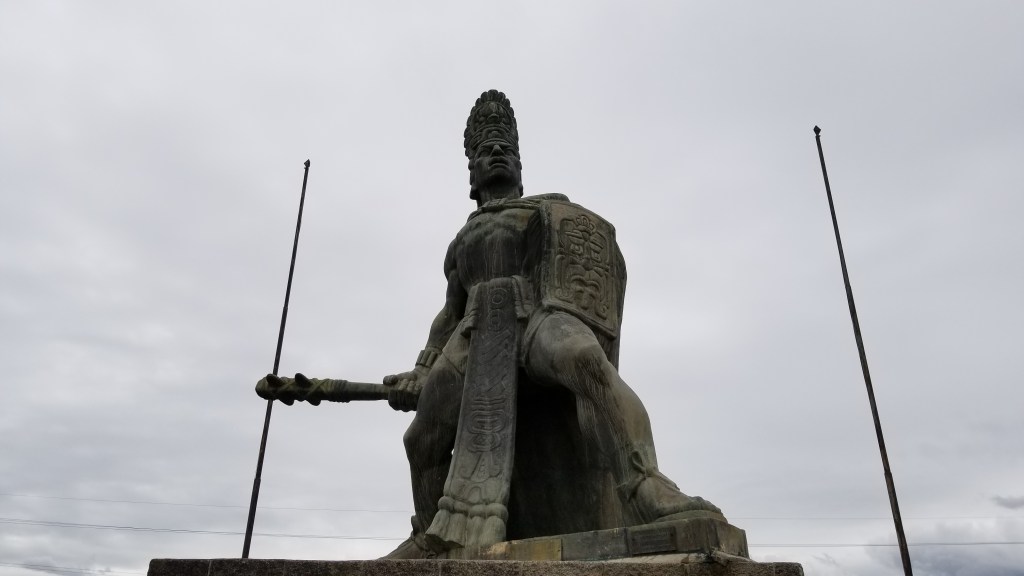
In the pre-Columbian era, or before European colonization, the Mayan civilization inhabited Guatemala, Southern Mexico, Belize, El Salvador, and Honduras. Music was an important part of their lives, as they used it for rituals, dances, and celebrations. They developed several instruments including the drum, flute, and trumpet. In the early 14th century, Spain invaded Guatemala and brought with them their Western instruments and music traditions, including sacred and liturgical music. The larger Maya communities suffered the most at the time of conquest, like the K’iche’, as they fought directly against the Spanish and lost, losing thousands of lives, their capital, and their lord Tecun Uman (who is considered a legendary figure to Guatemalan history).
Unlike Hernan Cortes’ comparatively fast conquest of Mexico in 1521, Guatemala was a difficult target for the conquistador Pedro de Alvarado, since the Maya people were “an array of small but tenacious groups [that] had to be confronted one by one.”[1] Those who fell were forced to convert to Christianity, which in turn affected their music as they were either discouraged or banned from performing their traditional music, and even had their instruments destroyed. This was done to strip them of their identity and to incorporate them into Hispanic culture. The instruments that the Spaniards brought include the guitar, violin, harp, and organ, and were quickly integrated into the music of the Maya people. Another instrument brought by the Spanish was an early version of clarinet, known as the chirimía, that is comparable to the shawm.[2] Alvarado’s war on the Maya was fought well past his death in 1541, with many Maya communities holding off the Spanish rule and defeating them before they were eventually conquered. This is a testament to the resilience of the Maya people.
In the 17th century, European music continued to spread throughout the country and schools were established to train the Maya people in music. Many of the Maya resisted this though and attempted to revert to their former ways, which resulted in a blend of Indigenous and European music. As the two cultures mixed, a prominent group of people known as Ladinos became present. This is the Central American word for mestizos, or people of mixed descent of European and Indigenous blood.
The traditional songs that resulted from this fusion are called son (plural sones), which is a generic term for instrumental songs throughout Latin America.[3] The sones in Guatemala are called son chapin, son guatemalteco, and son maya, as an indication of its country of origin. These sones are harmonically simple, typically following a I, IV, V7 roman number analysis, that gives it a danceable, folk-like quality. They also utilize a 6/8-time signature that is used heavily in Guatemala and allows for a rhythmic swing to occur. The sones include the use of hemiola, a technique of rhythmic displacement that puts emphasis on different beats in a measure to give the illusion to the listener that the time signature has changed. This technique will be heard later and is shown when the time signature feel shifts from 6/8 to ¾ time. They are free in form and are like jazz in the way of featuring the introduction of a theme followed by improvisation by the performer. This is a technique that comes from African influences. Below is an example of a son maya, accompanied by dancing.
Approaching the 18th century, the Indigenous Maya continued to integrate with the Spanish through the church. Rafael Antonio Castellanos was a significant Guatemalan classical composer of the time because he incorporated traditional folk idioms into his classical music. Castellanos used indigenous rhythmic vitality and syncopated dance-like beats that emulated the traditional music of the Indigenous within the confines of sacred music. His pioneering would pave the way for future composers to further push the boundaries. Below is a clip of one of his works titled “Negros de Guarangana.” This piece features a 6/8-time signature, which is highly used in Guatemalan sones, and a call-and-response chorus that is influenced by African musical traditions. Notice the unique addition of maracas, which was not typically used within this sacred context.
In the 19th century, composer Jose Escolastico Andrino was key to the development of music as he introduced and popularized European Romantic music styles in Guatemala. Like Castellanos before him, he was able to incorporate Guatemalan techniques into the European style of music. Due to his work, he established the first music conservatory in Guatemala which allowed for structured musical training. He was among the first Central American composers to write a work for soloist and orchestra, his Andante and Variations for violin. This work is heavily influenced by Western music traditions, as it is highly lyrical and emotive, and follows the popular form of theme and variations, but may still evoke subtle characteristics of Guatemalan music. Notice the dance-like feel of this piece as well as its simple and repetitive melody, all reminiscent of Guatemalan techniques.
In the 20th century, classical music was growing exponentially in Guatemala. This was greatly helped by composers Jesus and Ricardo Castillo, both pianists and composers. Both composers studied abroad in France and brought back “the ultimate trends of musical development”[4] and incorporated it into their music. In Jesus Castillo’s piece Fiesta de Pajaros, translating to Bird Festival,it features a sound comparable to a Frederic Chopin waltz, as well as his own personal work of emulating birds. Castillo was a pioneer in researching Maya music and dictated the songs of the native birds of Guatemala, as these were melodies frequently used by the Maya K’iche’.[5] Listen for the reoccurring trills, quickly ascending and descending passages, high tessitura, and constant moving passages, which are indicative of birds in flight. At this time, prominent teachers from Europe began teaching music in Guatemala as well. This is when a nationalist style developed, as composers used their newfound European techniques and blended them with Indigenous characteristics. This development has continued to present day, as composers continue to study abroad and bring back Western influences and fuse it with Guatemalan techniques.
In the present day, Guatemala’s population is over 17 million people. Nearly half of the population consists of the 22 Indigenous Maya communities like the Mam, Quiché, Q’anjob’al, and Achi. It is one of the only countries in Latin America that has such a high population of the Indigenous. A very small percent is Afro-Guatemalans, Garifuna, or mixed African and Indigenous Caribbean descent. Guatemalan music is the synthesis of three cultures blending: the Maya, African, and European. Two aspects make the identification of the Maya people’s music difficult. The first being due to the various communities, it is hard to generalize as they are each unique and have yet to be studied thoroughly. Second, through the passage of time and introductions to new people and experiences, each culture fuses together to create something new. For example, In the Nobel Peace Prize winner, living Guatemalan Indigenous human rights activist, Rigoberta Menchu’s self-titled book about the horrors the Maya had to face during the Guatemalan Civil War, she writes that the chirimia is a traditional instrument used by her Maya ancestors. Although this is partially true, it is not the whole truth as the chirimia was brought over by Spain, so it was not used by her pre-Columbian ancestors.[6] This is where the challenge lies when identifying musical characteristics of the Maya and African influences as they blend and become part of each other’s identity.
[1] George W. Lovell, Conquest and Survival in Colonial Guatemala, Fourth Edition: A Historical
Geography of the Cuchumatán Highlands, 1500-1839 (Montreal: McGill-Queen’s University Press, 2015), 55.
[2] Dale A. Olson et al., The Garland Handbook of Latin American Music (New York: Routledge, 2008), 53.
[3] John Mendell Schechter, Music in Latin American Culture: Regional Traditions (Schirmer Books, 1999), 87.
[4] Xavier Beteta, “Compositional Techniques in Rodrigo Asturias’s ‘El Banquete de las Nubes,’”(MM thesis, University of Cincinnati, 2006), 11, OhioLink.
[5] Nicolas Slonimsky, Music in Latin America (Thomas Y. Crowell Company, 1945), 203.
[6] Robert Neustadt, Reading Indigenous and Mestizo Musical Instruments: The Negotiation of Political and Cultural Identities in Latin America, 2007.
*This is an excerpt from Marie Gallardo’s DMA Lecture Recital on Guatemalan Music for the Clarinet presented on November 16, 2024 in Grant Recital Hall at the University of Missouri – Kansas City Conservatory.


Leave a Reply