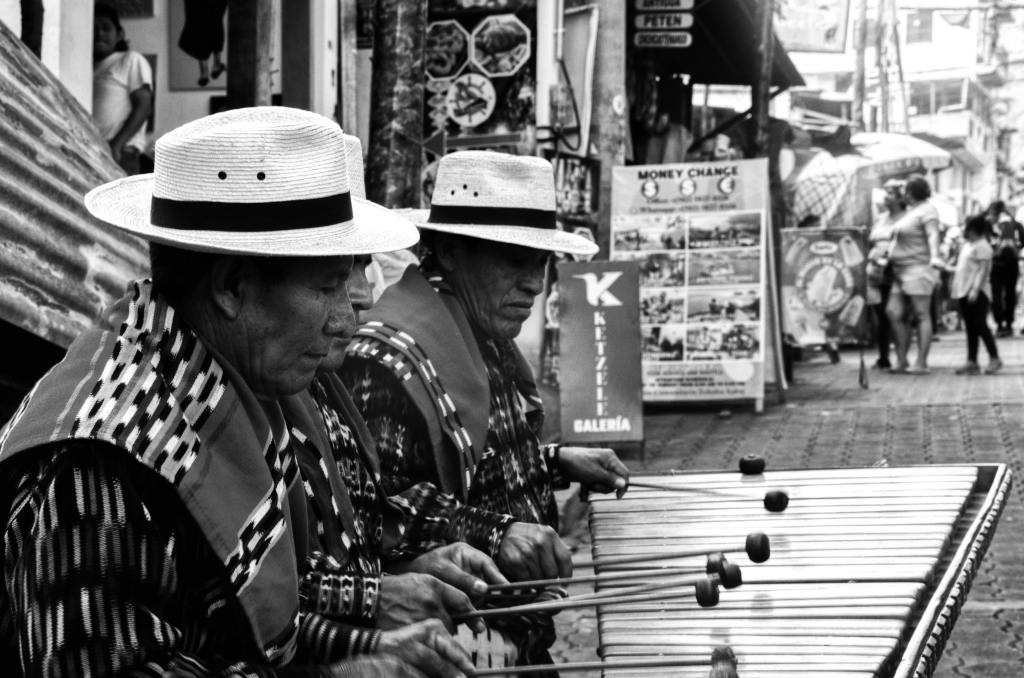
The marimba is an incredibly important instrument to the people of Guatemala. The marimba is known as their national instrument and is part of the identity of the people. The origins of this instrument are highly debated whether the Mayans had the instrument pre-Columbian era or if it was discovered when the Africans were brought over during the slave trade. Regardless of its exact origin, the Maya people have long used the instrument in their music. Known as the “wood that sings,” the marimba is incorporated into many aspects of life in Guatemala.
There are three variants of the marimba that are used in Guatemala. The Maya people originally used the marimba de tecomates, or marimba with gourds, and when played, it is often accompanied by dancing. This instrument is suitable for one player.
The marimba sencilla, translating to simple marimba, is one of the two widely utilized marimbas by the Guatemalans. The Ladinos and Maya people living in towns use this marimba often. It consists of a single row of keys of four to five octaves and is large enough to have up to four musicians playing at once. The son chapin and son guatemalteco are typically played by the marimba sencilla. Although this instrument is diatonic, it is not tuned within the European equal temperament scale, which makes it unsuitable for Western music.1
The marimba is a symbol of the Maya resistance and resilience to any subjugation the Maya people have faced. Through all their struggles: including colonization, forced incorporation in Spanish culture, losing their homes and land, they have always attempted to preserve their music through the marimba. The Maya people “view the land as a living being…the marimba symbolizes human connection to flora and fauna, and musical performance connects important live events to the natural entities in the natural surroundings.”2
Despite being conquered, the Maya would play the marimba in secret and incorporate their music with the Spanish techniques. In modern times, the Maya consistently used the marimba for all important musical events in their lives, even when the upper-class Guatemalans thought less of them for it. This subtle protest has allowed them to maintain their identity.
The last type of marimba is the most common, known as the marimba doble, it is the chromatic marimba that is intended to emulate the piano, as it has the addition of another row of keys like the black keys on a piano. The invention of this instrument is also highly debated whether it was invented in Chiapas, Mexico in 1897, or in Guatemala by Sebastian Hurtado in 1894.3 All of this debate surrounding the marimba indicates how important the instrument is to the Guatemalan people, as they want to claim its initial invention and development.
Regardless of its exact origin, the marimba doble brought the marimba into the middle and upper classes of Guatemala and made it into the national instrument. For centuries, the marimba was viewed as an instrument only for the Indigenous Maya, a peasant instrument. But due to the invention of the marimba doble, it brought new possibilities for the marimba and was incorporated into the lives of the upper classes by arranging dances for the instrument like waltzes, mazurkas, foxtrot, and swing. The marimba was coined as the national instrument of Guatemala in 1978 and is performed daily on Guatemalan radio. The marimba serves as a symbol of Maya resistance and pride, and a newfound appreciation for Ladinos.4
Sources:
1 Logan Elizabeth Clark, “The Mayan Marimba and the Musical Production of Place in a Transnational Migrant Community,” (PhD diss., University of California, Los Angeles, 2017), 43, ProQuest Dissertations & Theses Global.
2 Ibid.
3 John Mendell Schechter, Music in Latin American Culture: Regional Traditions (Schirmer Books, 1999), 91.
4 Ibid.
*This is an excerpt from Marie Gallardo’s DMA Lecture Recital on Guatemalan Music for the Clarinet presented on November 16, 2024 in Grant Recital Hall at the University of Missouri – Kansas City Conservatory.
 Guatemalan Music for the Clarinet
Leave a comment